
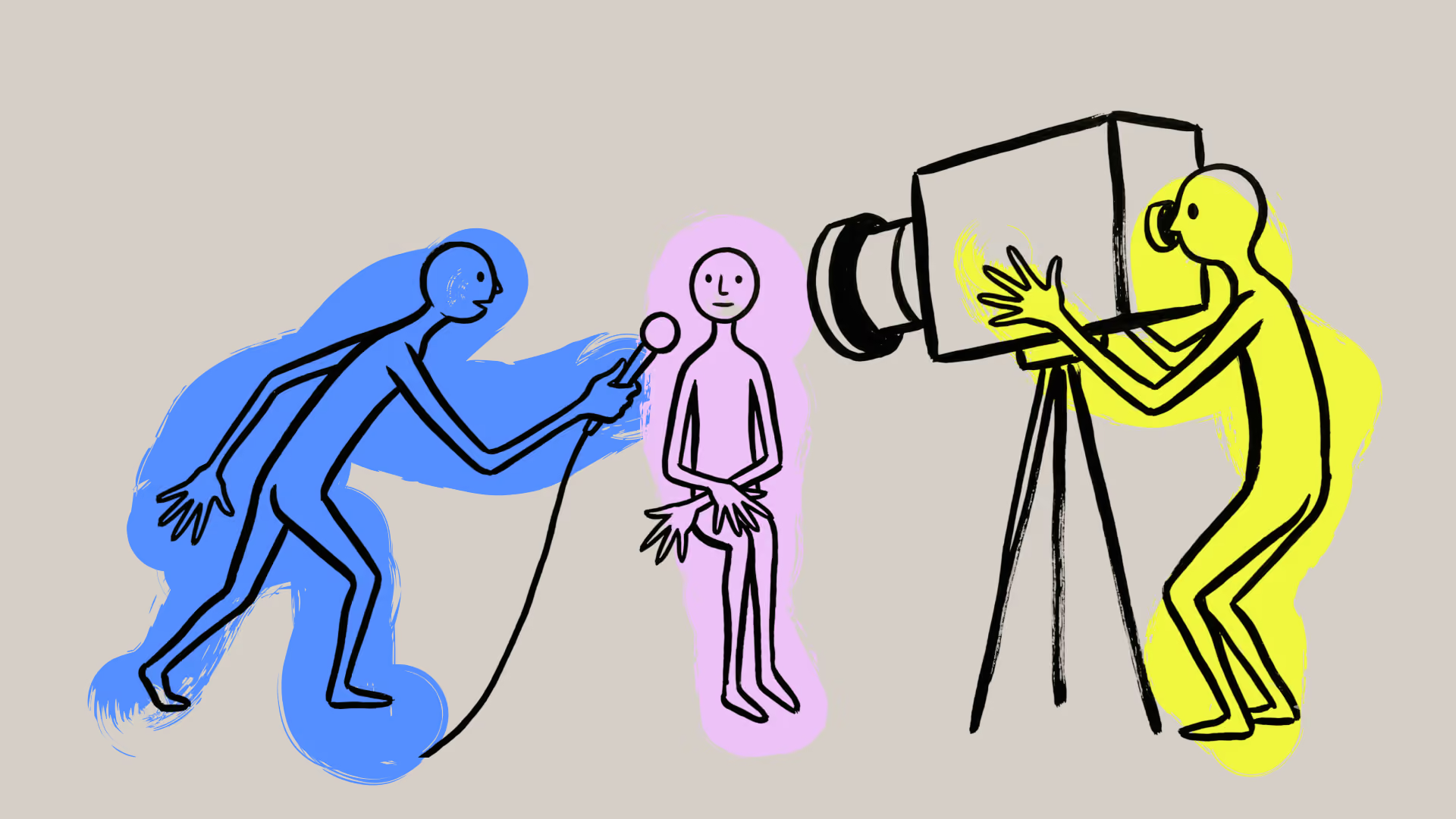
When I worked in journalism, you could usually tell within about fifteen seconds whether an interview was going to go well. The tell wasn't the first answer, it was the first breath. Confident founders took a moment, considered the question I'd actually asked, and then spoke. Nervous ones answered the question they'd rehearsed and raced to the end of it. By the time the story ran, that small difference in pacing showed up in who got a great quote and who ended up as a reluctant paragraph halfway down.
Most founders and business leaders I speak to now are somewhere between mildly anxious and quietly terrified about media interviews. That's a reasonable reaction. A good interview can unlock investors, customers and staff. A trainwreck live interview can follow you around for years, screenshotted and reshared. The gap between the two outcomes is almost entirely preparation, and almost none of it is about being slick.
This is a practical guide to preparing for a media interview in New Zealand, written from the other side of the desk. I've spent plenty of time as the journalist asking the questions, and plenty more as the PR person watching founders answer them. What follows is what actually works, not what sounds impressive in a media training deck.
What journalists are actually looking for
It helps to start with what the journalist in front of you needs. They are not trying to trip you up. In New Zealand in particular, most journalists are stretched thin, working against the clock, and genuinely interested in getting your story right. What they need is a clear sense of what's new, a few specific details that bring the story to life, and one or two quotable lines they can use without having to paraphrase you.
If you give them those three things, you will be quoted accurately, your story will land, and you'll be called again. If you give them vague answers, no specifics and a rehearsed script, you'll be filed under "not worth the effort" and the next press release that crosses their desk might not get opened.
The best interviews I ever did as a journalist weren't with the smoothest operators. They were with founders who were themselves, who told me something I didn't already know, and who trusted me enough to be specific. You don't need to be charming. You need to be useful.
Before the interview: research, messaging, anecdotes
Most interviews are won or lost in the hour before they start. Three things deserve your attention.
Research the journalist and the publication. Read their last five or six articles, not to flatter them on the call, but to understand what they cover, how they cover it, and who their audience is. A journalist who writes about climate policy for a business audience wants a very different story from one who writes about founders for a tech readership. If you don't know the answer, ask your PR contact or check their byline history. I wrote about this in more detail in our guide to pitching journalists, and the same principle applies once the meeting is in the diary.
Land on three key messages and stop. Every useful interview I've ever been part of boiled down to three things the founder wanted the reader to walk away with. No more. If you try to cover eight points, you'll cover none of them well. Write your three messages down, make them short enough to say in a single breath, and know which one matters most. If the interview runs long, the journalist will remember the thing you kept coming back to.
Build an anecdote bank. Journalists quote moments far more often than they quote arguments. The founder who says "our platform saves users four hours a week" is forgettable. The founder who says "one of our early users told me she'd spent twelve years filing paper forms for her dairy herd and the first night she used us she got her kids to bed on time for the first time in a month" is the one who makes the story. Before any interview, sit down and write out five or six specific customer stories, user moments or turning points you've lived through. You won't use all of them, and you shouldn't try to. But having them in your back pocket means you never freeze when a journalist asks for an example.
Two types: live or not live (and pre-recorded)
Before we go any further, it's important to talk about the two key types of interviews that media do:
Live: On air broadcast live interview for TV or radio. In New Zealand, radio is the more common of the two, but TV live interviews also still exist: especially on TVNZ's Breakfast morning show, the political show Q&A and also ThreeNews do them on their 6pm bulletin sometimes. Unsurprisingly, a live interview is exactly what it says on the tin: it's a live broadcast interview going out to tens or hundreds of thousands of people directly. So what you say is what gets broadcast. Unsurprisingly then, the stakes are way higher and the room for error is way less – that's why these make people understandably more nervous than the second type of interview...
Not Live, or sometimes called "Pre Recorded": These are the most common types of interviews and can either be for print – generally the reporter will record the interview on their phone and/or make notes on their notebook, sometimes in the dying art of shorthand – or for radio/TV broadcast in which the interviewee is recorded to then be clipped up into short (10s roughly) soundbites to form part of a larger story. Or, the other type of not live interview is a "pre-recorded" interview for TV or radio (or, of course their online medium equivalents) which is a longer conversation recorded with someone, then broadcast to sound like it is a live interview – but it isn't. Typically, these pre-recorded have a tiny bit more room for error than an actual live interview as they will often be edited down a bit, to remove awkward pauses, to shorten lengthy responses, and to fit a certain desired length to fit in the programme.
For the purposes of this article, we're going to concentrate on the second type of interviews: not live. We'll cover live interviews in a seperate post soon.
On the day: environment, logistics, mindset
For remote interviews, the basics still get people. Good light, a clean background, a wired internet connection if you can manage one, a decent microphone, no pets in the room if it's a serious topic. These sound trivial, but watching a CEO's video freeze mid-sentence and skip their most important quote is something the journalist will remember long after they've forgotten what you said.
For in-person interviews, arrive ten minutes early, bring a notebook with your notes so you can refer to them between questions, and take your time. Between questions, don't be afraid to pause, look at your notes, take a deep breathe and truly think about your response before answering.
The mindset part is the one most founders skip. An interview is a platform being offered to you, not an interrogation, even when the questions get sharp. If you walk in expecting a gotcha, you'll sound defensive even when the questions are friendly. If you walk in expecting a useful conversation, you'll sound generous even when the questions are hard. Same words, completely different energy.
During the interview: bridging, specificity, silence
The single most useful technique in a media interview is called bridging, and every spokesperson who has ever been trained knows it. Bridging means hearing a question, answering the part of it you can answer honestly, and then moving the conversation to the message you want to make. It sounds like "That's a fair question, and here's what I can tell you... but the thing that's really interesting about where we are right now is..."
Done well, bridging feels natural and leaves the journalist with something better than the answer they were fishing for. Done badly, it reads as evasion. You'll see politicians guilty of this all the time. The trick is to actually answer the question first, then add. If you skip straight to the pivot, you've given the journalist a quote that reads as "refused to comment on X".
Specificity is the second thing that separates good interviews from forgettable ones. Numbers, named customers, real dates, real cities, real decisions. If you can say "we grew from three staff in Christchurch to twenty-seven across three offices in eighteen months", that's a usable sentence. If you say "we've grown significantly", that's filler, and it will be cut.
The third, which sounds obvious but almost nobody does it, is to leave room for silence. Journalists are trained to wait. If you stop talking and they don't fill the gap, the instinct is to keep talking to cover the awkwardness, and that's where founders volunteer the thing they didn't mean to say. The fix is simple: answer the question, stop, and let them ask the next one. You're allowed to be comfortable with a pause.
Common traps (and how to handle them)
A few patterns catch out first-time founders more than anything else.
- Answering the question you wish they'd asked. It reads as scripted and the journalist will push back harder. Answer what they actually asked first, then bridge.
- Saying "no comment". It sounds guilty even when you're innocent. Better alternatives: "I can't speak to that specific case, but what I can tell you is..." or "That's still confidential, but I'm happy to talk about..."
- Getting defensive on hostile questions. Defensiveness reads as evasion. The best response to a pointed question is a calm, specific answer, not a long justification. If the question is genuinely unfair, you can say so, once, and move on.
- Over-explaining the technology. If you run a deep-tech business and a generalist journalist asks what you do, resist the urge to explain the physics. Explain the outcome. The founders at Kea Aerospace do this brilliantly; so do the team at Contented. They talk about what their technology lets customers do, not how it works at the chip or model level.
- Rehearsing until you sound rehearsed. There's a version of preparation that makes you sound robotic. If you catch yourself repeating phrases verbatim across three interviews, change it up. The quotes that get used are the ones that sound spontaneous, even when they're not.
After the interview: fact-checking, expectations, patience
Once the interview is done, resist the urge to message your PR person with "how did I do?" within the first ten minutes. Nobody knows yet, including the journalist. The story will be shaped in editing, and you won't see it until it's live or close to it.
A few practical expectations to set. You will usually not get to see the article before it's published. You can ask, politely, and some journalists will check a specific quote with you for accuracy. Most will not, and that's fine. What you are entitled to is factual correction if something is wrong. If the article says you raised $50,000 when you raised $500,000, that is worth a polite email. If the article uses a quote that makes you cringe, but is totally accurate, that is not. You'll be surprised how different we all feel like we sound when we see ourselves quoted in print.
Patience matters too. A great article doesn't arrive the day you want it to. It arrives when the news peg lines up, the journalist has space, and the editor signs off. If you've done your job well in the interview, your story gets told. If you keep sending follow-up emails asking when it's going live, you damage the relationship.
When to get formal media training (and when not to)
For most NZ founders doing their first few interviews, what I've written above is enough. Read the journalist's work, nail three messages, bring specific anecdotes, bridge without dodging, never treat anything as off the record, and stop talking when you're done. That's ninety percent of media training in four sentences.
Formal media training earns its place in a few specific situations. If you're about to announce a funding round that will draw national attention. If you're in a regulated industry where a careless comment has compliance implications. If you're heading into a crisis and you need to rehearse difficult questions with someone who will push you hard. Or if you genuinely freeze on camera, which is more common than people admit, and no amount of general advice fixes it.
We build media training into our Heavy retainer because we've seen what a difference a single workshop makes before a founder steps into the spotlight. But for most one-off interviews, good prep and honest self-awareness will get you there. If we talk to a founder who only has one interview coming up, we'll usually tell them to save their money and read this article twice.
That's always been our bias: tell people honestly what they need, and only sell them the bigger package when it genuinely serves them. If you want a straight conversation about whether you need training, a one-off pitch, or something more structured, we're happy to have it.
Get in touch here and we'll give you a straight answer.